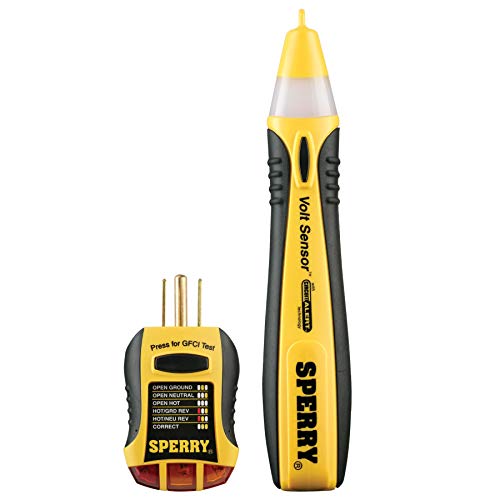
Sperry Instruments STK001 Non-Contact Voltage Tester (VD6504) & GFCI Outlet / Receptacle Tester (GFI6302) Kit, Electrical AC Voltage Detector, Yellow & Black


Key features
- •Verify the presence of AC voltage prior to working on electrical installation or troubleshooting
- •Standard 3-wire and GFCI protected 120V outlets. The tester is protected
- •Detects the presence of AC Voltage and tests for wiring errors in wall outlets as well as GFCI operation
- •Non-contact sensing circuit senses voltage from 80-1000V AC
- •Compact ergonomic design with over-molded rubber grips
Sperry Instruments STK001 Non-Contact Voltage Tester (VD6504) & GFCI Outlet / Receptacle Tester (GFI6302) Kit, Electrical AC Voltage Detector, Yellow & Black
List Price: $38.76$34.88DEALYou Save: $3.88 (10%)
Free shippingFree Returns – 30 daysFree Order CancellationSecure Payment2–3 Days DeliveryGet It October 26, 2026In Stock (8)No marketing spamNo account requiredFulfilment by FedEx / Amazon / UPS / ShipwirePayPal / Card Buyer Protection
Customer Reviews
Reviews sourced from verified Amazon purchasers4.3
out of 5
Based on 10 reviews
5★
40%
4★
30%
3★
0%
2★
10%
1★
20%
You Might Need This & Not Realize It
B✓ Verified Purchase•June 6, 2018
Probably anybody buying one of these knows what they do: they detect AC voltage from 12 to 1000 volts (12-1000VAC) not by using a meter, or by physically contacting the electrified part, but by getting this device near. They are in common use by professionals and others that regularly work with, or could be exposed to dangerous AC voltages & current. Telephone repair workers, for example, carry them because they don't know when some enclosure they're unfamiliar with might be electrified.
For others: have you ever touched an appliance that was wired to a faulty AC receptacle or with an incorrectly wired ground & gotten shocked? Have you ever looked at some exposed wires & wondered if they were "hot?"
I used this the day I got it. I had some plug-in lights that were out. I knew the AC receptacle was putting out power because I tested that, so the fault must have been somewhere in the string. I used this and quickly found out exactly where the break was, and fixed that. Day one I probably saved 45 minutes, and I wasn't even using it for what I intended to.
AC power can be a tricky thing, even in residential settings. The notion of "hot," "neutral," and ground are dissimilar to the DC world, & can easily get messed up if work has ever been done on any AC wiring. Having a device like this helps one to avoid dangerous voltages. You can even trice wires in walls!
I set the "sensitivity" by getting it near an AC receptacle I knew was good, & then turning the sensitive knob until it reliably registered when near the receptacle. I wish their was a more scientific way of setting the sensitivity, but the manual didn't have any instructions regarding setting sensitivity.
If you've ever been zapped by an improperly w
For others: have you ever touched an appliance that was wired to a faulty AC receptacle or with an incorrectly wired ground & gotten shocked? Have you ever looked at some exposed wires & wondered if they were "hot?"
I used this the day I got it. I had some plug-in lights that were out. I knew the AC receptacle was putting out power because I tested that, so the fault must have been somewhere in the string. I used this and quickly found out exactly where the break was, and fixed that. Day one I probably saved 45 minutes, and I wasn't even using it for what I intended to.
AC power can be a tricky thing, even in residential settings. The notion of "hot," "neutral," and ground are dissimilar to the DC world, & can easily get messed up if work has ever been done on any AC wiring. Having a device like this helps one to avoid dangerous voltages. You can even trice wires in walls!
I set the "sensitivity" by getting it near an AC receptacle I knew was good, & then turning the sensitive knob until it reliably registered when near the receptacle. I wish their was a more scientific way of setting the sensitivity, but the manual didn't have any instructions regarding setting sensitivity.
If you've ever been zapped by an improperly w
Waste of money.
Frank✓ Verified Purchase•October 12, 2017
I first saw how many reviews it had and the stars it had and thought this would be a good item to get. I mean how can all these 1k reviews be wrong? When I first received the 3 sperry testers I was super excited. The size was perfect, compact and it doesn't block the outlet either above or below of the one you plug it into. They felt solid and the rubber molding on the sides was a nice feature. I go to plug it into an outlet and Major disapointment. It was so difficult to tell which lights were on. The small bulbs in there are not bright so they are hard to see during the day time and worse of all the light of one bulb will bleed into the compartment of the bulb next to it making it seem like the other bulb is on also on. I believe a tool should help you solve problems, not add the problem of then trying to decipher what code its throwing with the lights. So I start plugging in the other 2 sperry testers and find out one of the testers has a bulb that won't light. Bummer but hey it happens things get dropped during shipping etc. But what was really concerning to me was the bad reading for open ground. I plug the tester into an outlet that has no ground hooked up to it and it would read as correctly wired. I was already going to return because of how difficult it was to read it due to the bad lighs but this was really reassuring I was doing the right thing sending it back. Trust me, I am not the type of person to send back items for something minor things but this just adds problems. I recommend you go for a different tester.
Nice Tester but Care Must be Exercised in Understanding Lights
J. S.✓ Verified Purchase•June 21, 2017
Out of the package, with minimal understanding of operation, this one isn't a good choice, here's why. After buying this (and it's a lovely, practical, pleasing design), the very first use I experienced a receptacle similar to one that another reviewer claimed he failed a Home Inspector Test because of, he thought the receptacle wiring was good, the instructor's receptacle tester showed an open ground.
With this tester, a receptacle, with an open ground, lights one light brightly, one slightly less bright, and one dim. I bought this tester to replace one that I thought I lost but has since shown up. It only lights one light for an open ground. As we're working to get a contractor to rewire a house, I mentioned this effect to several electricians, and their socket testers, different models, only lit one light too. I purchased another receptacle tester on Amazon, it has 5 lights, but only one lights for each defect, and a green light for good. It's a keeper. Big, but I love it.
My new one, the "Sperry Instruments HGT6520, Stop Shock II - Single LED Indicator, GFCI Outlet Tester" available on Amazon, has multiple LEDs, only one lights for any one condition, the LEDs are red to denote a defect and green for correct wiring. In addition, the tester requires less than 10 ohms resistance to denote a normal ground, so poor ground conditions are flagged too, not just missing grounds.
Mind you, some reviewers here are fond of this model (the one this review is about) but careful attention needs to be given to the brightness of the lights. One article online said not to use any receptacle testers, but I disagree. As an industrial electrician, we have these, but we usually use a voltage tester, but you have to know what to expect, and exposed voltage tester lead ends are hot when plugged in. Receptacle testers work just like using a plug, so it's safer. There's one site online that has an extended chart of conditions, and what to expect from the lights, including dim lights. It's worth the effort to find, it would make this tester easier to use and understand.
With this tester, a receptacle, with an open ground, lights one light brightly, one slightly less bright, and one dim. I bought this tester to replace one that I thought I lost but has since shown up. It only lights one light for an open ground. As we're working to get a contractor to rewire a house, I mentioned this effect to several electricians, and their socket testers, different models, only lit one light too. I purchased another receptacle tester on Amazon, it has 5 lights, but only one lights for each defect, and a green light for good. It's a keeper. Big, but I love it.
My new one, the "Sperry Instruments HGT6520, Stop Shock II - Single LED Indicator, GFCI Outlet Tester" available on Amazon, has multiple LEDs, only one lights for any one condition, the LEDs are red to denote a defect and green for correct wiring. In addition, the tester requires less than 10 ohms resistance to denote a normal ground, so poor ground conditions are flagged too, not just missing grounds.
Mind you, some reviewers here are fond of this model (the one this review is about) but careful attention needs to be given to the brightness of the lights. One article online said not to use any receptacle testers, but I disagree. As an industrial electrician, we have these, but we usually use a voltage tester, but you have to know what to expect, and exposed voltage tester lead ends are hot when plugged in. Receptacle testers work just like using a plug, so it's safer. There's one site online that has an extended chart of conditions, and what to expect from the lights, including dim lights. It's worth the effort to find, it would make this tester easier to use and understand.
Very useful and handy, but troubling lack of certain indicator possibilities
Darren Levine✓ Verified Purchase•October 19, 2016
I really do like this device, now that I've figured it out, i know what to expect of it. I took off a star for the lack of clarification on the device about odd readings (readings that are not described)
So, I've seen some reviews about light bleeding from one light to another, giving a somewhat confusing reading. This isn't light just bleeding through plastic, the bulbs in there are indeed lighting up but very faintly. I rewired a bunch of outlets, and in the process learned a few things about this device:
-It's made very nice, feels good
-It Cannot diagnose every problem
-The chart does Not describe every possible indication you may see
-It Does let you know overall if something is wrong.
So, what i mean is that on the device it shows you a list of all possible light configurations. However, two situations are notably missing: all lights on, lights partially on. I've encountered situations where all lights illuminate, but the chart doesn't show this situation. I've also seen variations of lights being on, but only slightly. This is where i think some folks thought it was due to one bright light bleeding into the next light making it seem like it might be on, but it's really an indicator of some other issue. Either way, unless you get two solid orange lights, something isn't right.
You might think that they would mention this in the manual. Nope. Nothing. That's really unacceptable for a device intended for electrical work.
Overall, this device indicates two things reliably: Everything is OK, or something is Wrong. If you get anything but two solid orange lights, something to some extent is wrong. Even if i get solid light indications, i check everything again with a multimeter. You can get decent ones for around $25, and they will tell you exactly what's going on with the outlet. Why not just get a multimeter? That's certainly an option, but my preference is to have the little tester for blanket sweep checks of everything, marking the bad outlets, then going back and checking the bad ones with the multimeter to see exactly what's going on.
Bonus round:
Testing an outlet with a multimeter is easy: set it to voltage reading and: red probe to the (hot)small outlet slit, black to the (neutral)big slit. should be 120(ish) volts, then do red to small slit, black to ground (bottom outlet hole), should also be 120v. Then one probe to big slit, the other to ground, should be zero or near zero reading.
So, I've seen some reviews about light bleeding from one light to another, giving a somewhat confusing reading. This isn't light just bleeding through plastic, the bulbs in there are indeed lighting up but very faintly. I rewired a bunch of outlets, and in the process learned a few things about this device:
-It's made very nice, feels good
-It Cannot diagnose every problem
-The chart does Not describe every possible indication you may see
-It Does let you know overall if something is wrong.
So, what i mean is that on the device it shows you a list of all possible light configurations. However, two situations are notably missing: all lights on, lights partially on. I've encountered situations where all lights illuminate, but the chart doesn't show this situation. I've also seen variations of lights being on, but only slightly. This is where i think some folks thought it was due to one bright light bleeding into the next light making it seem like it might be on, but it's really an indicator of some other issue. Either way, unless you get two solid orange lights, something isn't right.
You might think that they would mention this in the manual. Nope. Nothing. That's really unacceptable for a device intended for electrical work.
Overall, this device indicates two things reliably: Everything is OK, or something is Wrong. If you get anything but two solid orange lights, something to some extent is wrong. Even if i get solid light indications, i check everything again with a multimeter. You can get decent ones for around $25, and they will tell you exactly what's going on with the outlet. Why not just get a multimeter? That's certainly an option, but my preference is to have the little tester for blanket sweep checks of everything, marking the bad outlets, then going back and checking the bad ones with the multimeter to see exactly what's going on.
Bonus round:
Testing an outlet with a multimeter is easy: set it to voltage reading and: red probe to the (hot)small outlet slit, black to the (neutral)big slit. should be 120(ish) volts, then do red to small slit, black to ground (bottom outlet hole), should also be 120v. Then one probe to big slit, the other to ground, should be zero or near zero reading.
Better than the two-light solutions
Eric Perez✓ Verified Purchase•October 13, 2016
I knew something was up when my GB Electrical 'two-light' outlet tester that I've been using for years told me a circuit was wired correctly but when I used a GFCI tester on a GFCI outlet it did not trip. The GB unit has been pretty reliable but I knew it was not giving me correct information in this case which was my impetus for buying this newer, digital/single LED tester.
You can see in the pictures attached to this review that this Sperry LED unit is correctly showing a bad ground and the other tester showing the two rightmost lights turned on--that means it's saying the outlet is wired correctly (which it is not.)
Also, in case anybody is wondering this Sperry unit has the labels for the LEDs on both sides so you can still read it even if the outlet is upside-down.
You can see in the pictures attached to this review that this Sperry LED unit is correctly showing a bad ground and the other tester showing the two rightmost lights turned on--that means it's saying the outlet is wired correctly (which it is not.)
Also, in case anybody is wondering this Sperry unit has the labels for the LEDs on both sides so you can still read it even if the outlet is upside-down.
Page 1 of 2