bayite DC 6.5-100V 0-100A LCD Display Digital Current Voltage Power Energy Meter Multimeter Ammeter Voltmeter with 100A Current Shunt



Key features
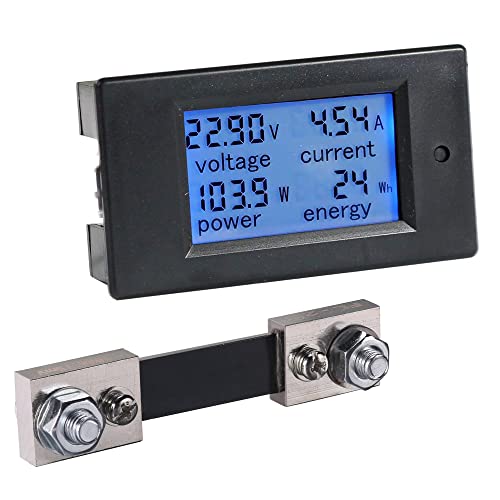
- •Test range: Voltage: DC 6.5~100V; Current: 0~100A; Power: 0~10kW; Energy: 0~9999kWh
- •Store energy data when power off(can be reset to 0). The blue backlight can be turned on/off manually
- •With overload alarm function(If active power is larger than threshold, backlight and power will flash)
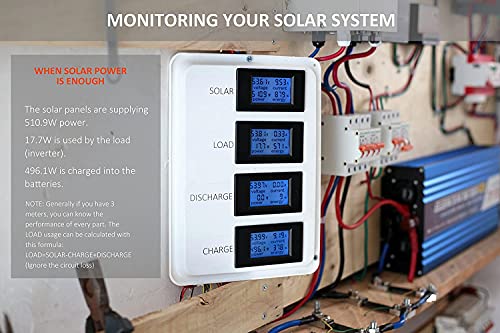
- •4 in 1 meter; Large-screen LCD (displays voltage, current, active power, energy at the same time)
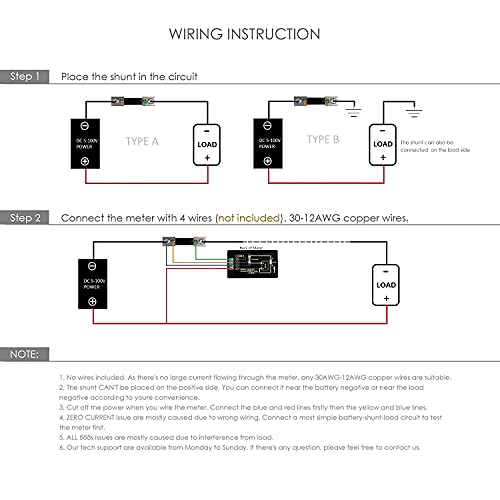
- •Note: Only display and shunt are included. It doesn't include any wire or accessories
bayite DC 6.5-100V 0-100A LCD Display Digital Current Voltage Power Energy Meter Multimeter Ammeter Voltmeter with 100A Current Shunt
List Price: $34.90$31.41DEALYou Save: $3.49 (10%)
Free shippingFree Returns – 30 daysFree Order CancellationSecure Payment2–3 Days DeliveryGet It October 24, 2026In Stock (2)No marketing spamNo account requiredFulfilment by FedEx / Amazon / UPS / ShipwirePayPal / Card Buyer Protection
Customer Reviews
Reviews sourced from verified Amazon purchasers4.5
out of 5
Based on 20 reviews
5★
75%
4★
25%
3★
0%
2★
0%
1★
0%
Great for 12 volt PV solar applications
DVD•October 20, 2017
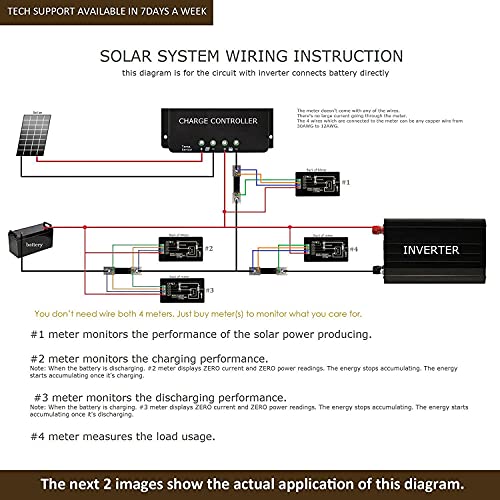
These devices are great for monitoring 12 volt PV solar system performance. I use two of these in my small RV. One is used to monitor solar panel output and battery charge rate using a 4P2T slide switch to select, the other to monitor battery discharge rate while running the DC-AC inverter. I compared the current and voltage readings to a FLUKE DVM and they were within 1% over much of the range (10-20v and 0-30A) of my application. It's really nice to see the accumulated solar energy from the PV panel array as well as total use by the RV.
Just a couple notes to anyone with a similar application: First locate the solar charge controller as physically close to the battery(ies) as practical and use the heaviest gauge COPPER (not copper clad Aluminum-CCA) possible. Good MPPT charge controllers have a battery charge algorithm that looks at the battery voltage on the terminals of the charge controller. Under heavy charging conditions there can be SIGNIFICANT voltage drop between the output of the charge controller and the battery terminals which can result in a less than optimum charge state for the batteries. Second MPPT charge controllers can generate quite a lot of electromagnetic noise which I found impacted the readings on these meters if the sense cable to the shunt was greater than a few feet. Adding decoupling capacitors to the meter inputs helped a lot.
Just a couple notes to anyone with a similar application: First locate the solar charge controller as physically close to the battery(ies) as practical and use the heaviest gauge COPPER (not copper clad Aluminum-CCA) possible. Good MPPT charge controllers have a battery charge algorithm that looks at the battery voltage on the terminals of the charge controller. Under heavy charging conditions there can be SIGNIFICANT voltage drop between the output of the charge controller and the battery terminals which can result in a less than optimum charge state for the batteries. Second MPPT charge controllers can generate quite a lot of electromagnetic noise which I found impacted the readings on these meters if the sense cable to the shunt was greater than a few feet. Adding decoupling capacitors to the meter inputs helped a lot.
I finally can monitor exactly what my motorhome battery system is doing - a must have for any RV owner
Daddio Dave•September 18, 2017
I purchased two of these bayite DC 6.5-100V 0-100A LCD Display Digital Current Voltage Power Energy Meter Multimeter Ammeter Voltmeter with 100A Current Shunt and installed them in my motorhome a month ago. I wired them so that one meter shows all current flowing out of the house batteries and the other shows all current flowing into the house batteries. I only needed to use one amp meter shunt at the negative terminal of my battery bank output to accomplish this. This arrangement has worked exceedingly well for me. Both meters show the identical voltage readings. With these meters I can keep easy tabs on what my electrical system is doing. I can tell what the current draw is for the various loads that I have (lights, water pump, standard dorm fridge, etc.) and the watt-hour meter lets me know how much my battery has been depleted (if you know the total capacity of your battery). It also lets me see what my battery charger is doing with regards to voltage and current delivery. The illuminated display uses hardly any current (3 milliamps) so I keep the light on all the time. It makes a great night light. So far both meters have worked great and were relatively easy to install. I can't believe I waited so long to install something like this. It's so inexpensive yet so helpful. A no-brainer.
EDIT 7/13/2018 - Meters are still working great and are very helpful. This should have been standard equipment. I added a photo showing how I cut out mounting holes for the two meters in a standard light switch plate and mounted this plate over a cutout on the interior cabinet wall.
EDIT 7/13/2018 - Meters are still working great and are very helpful. This should have been standard equipment. I added a photo showing how I cut out mounting holes for the two meters in a standard light switch plate and mounted this plate over a cutout on the interior cabinet wall.
Bayite DC 6.5-100V 0-100A LCD Display Digital Current Voltage Power Energy Meter Multimeter best remote start monitor for the $
Dr. Raya•June 16, 2017
Bayite DC 6.5-100V 0-100A LCD Display Digital Current Voltage Power Energy Meter Multimeter Ammeter Voltmeter with 100A Current Shunt is a very easy to install and use device to provide you instant on and off of higher power inverters, with the ability to monitor power consumption, watts being used when inverter is powered up, run time on the device, and how much current is going through the meter.
I placed a 5,000 watt inverter in the rear of my F350 Cargo van, connected to a deep cycle battery that has a line running from the main battery to it to help maintain the charge in the battery.
The way my monitor is wired I see instant power consumption, such as how much internal ceiling lights use when powering on, once on, meter drops back to zero.
Having the ability to remote start the inverter is a bonus, as I am rarely near the rear of the van after I have plugged in items being used at the time. A simple push of the button and I am ready to go, if I am at the rear and not near the power on button I can simply unlpug the remote and start up the inverter using switch on the device.
This is a must have to keep a watchful eye on power drain to insure you do not take the battery or batteries down to unsafe level.
Easy to install, although the instructions could use a major rewrite by someone with a much better command of the English language. If needed I would certainly purchase this device again and highly recommend it to those with a need for such a remote switching unit.
I placed a 5,000 watt inverter in the rear of my F350 Cargo van, connected to a deep cycle battery that has a line running from the main battery to it to help maintain the charge in the battery.
The way my monitor is wired I see instant power consumption, such as how much internal ceiling lights use when powering on, once on, meter drops back to zero.
Having the ability to remote start the inverter is a bonus, as I am rarely near the rear of the van after I have plugged in items being used at the time. A simple push of the button and I am ready to go, if I am at the rear and not near the power on button I can simply unlpug the remote and start up the inverter using switch on the device.
This is a must have to keep a watchful eye on power drain to insure you do not take the battery or batteries down to unsafe level.
Easy to install, although the instructions could use a major rewrite by someone with a much better command of the English language. If needed I would certainly purchase this device again and highly recommend it to those with a need for such a remote switching unit.
Fantastic
Cust8e0•May 15, 2017
I put this in my camping trailer and am using it to monitor DC amps. We plan to do a lot of dry camping and knowing our actual draw (vs what websites claim) goes a long way toward battery management. This comes with all the needed parts and with a bit of electrical background is an easy install.
Mounting this was not fun. I bought a wall plate at Lowes (used for light switch) and cut a rectangle hole in it for this. The tangs on the side of this unit didn't hold anything and broke very easily. I used hot-glue and it holds it tight.
Mounting this was not fun. I bought a wall plate at Lowes (used for light switch) and cut a rectangle hole in it for this. The tangs on the side of this unit didn't hold anything and broke very easily. I used hot-glue and it holds it tight.
Great addition to my class B motorhome
Johnny Superhawk•April 29, 2017
So far, excellent. A huge improvement over the stock battery monitor, relieves my battery anxiety on my class B. It's accurate to my $150 Klein voltmeter. The backlighting is not overly harsh, so I may just leave it on all the time. Viewing angle is good enough, but of course test that out before permanently installing.
My only beef is the pen button. I will probably try and glue a small extension on it, since it will get used regularly, such as for resetting the energy meter when setting up camp.
From this I should be able to get a good idea of the total Wh of the battery. Voltage alone doesn't say much.
The clips are designed for a thin panel. To mount it on plywood, I cut the back side at the plug in at an angle to allow clearance for the wire terminals, and just made the rest a friction fit within the wood cutout.
My only beef is the pen button. I will probably try and glue a small extension on it, since it will get used regularly, such as for resetting the energy meter when setting up camp.
From this I should be able to get a good idea of the total Wh of the battery. Voltage alone doesn't say much.
The clips are designed for a thin panel. To mount it on plywood, I cut the back side at the plug in at an angle to allow clearance for the wire terminals, and just made the rest a friction fit within the wood cutout.
Page 1 of 4