Nooelec GOES Weather Satellite RTL-SDR Bundle - Includes NESDR SMArTee XTR Software Defined Radio, & Everything Else Needed to Receive LRIT, HRIT & HRPT Satellite Weather Images Directly from Space!


Key features
- •This bundle will allow you to receive detailed, high-resolution, near real-time images from orbiting weather satellites. With as little as an hour of setup, you will be receiving LRIT, HRIT and HRPT GOES transmissions, error-free and with ease!
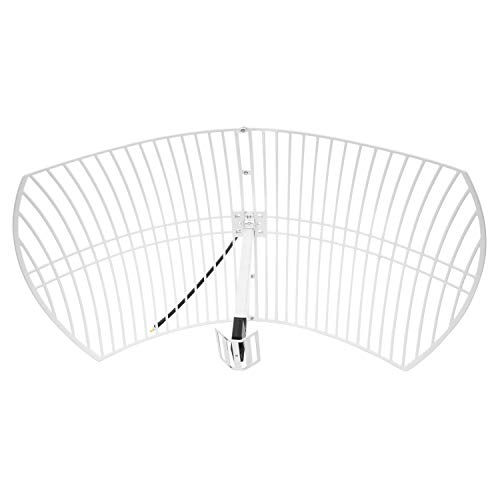
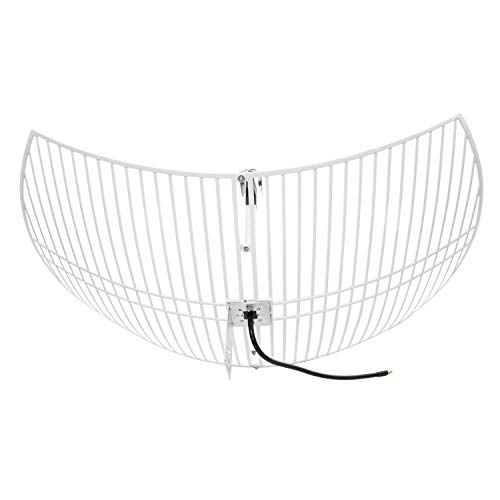
- •This GOES Weather Satellite SDR bundle includes a GOES parabolic reflector antenna, NESDR SMArTee XTR SDR receiver, SAWbird+ GOES LNA module, 10m LMR400 cable, and the other cables and adapters required for a full GOES receiver. Just add a host device and software, and you are ready to go
- •The 21dBi antenna is meant for high gain L-band applications where the antenna is stationary. The center frequency is 1.75GHz, and bandwidth is 200MHz or greater. This encompasses many popular weather satellite applications and constellations
- •Software is required for the decoding of images. Current options are either free Linux-based decoders or a paid version of XRIT Decoder for Windows (a license is NOT included in this bundle!). A virtual machine can be used for Linux instead of a standalone Linux computer or Raspberry Pi, if preferred.
- •IMPORTANT: This bundle is NOT suitable for EWS-G1 reception (formerly GOES-13)! If there are questions about your particular application, please contact our support team for assistance! support.nooelec.com
Nooelec GOES Weather Satellite RTL-SDR Bundle - Includes NESDR SMArTee XTR Software Defined Radio, & Everything Else Needed to Receive LRIT, HRIT & HRPT Satellite Weather Images Directly from Space!
List Price: $276.38$248.74DEALYou Save: $27.64 (10%)
Free shippingFree Returns – 30 daysFree Order CancellationSecure Payment2–3 Days DeliveryGet It October 26, 2026In Stock (1)No marketing spamNo account requiredFulfilment by FedEx / Amazon / UPS / ShipwirePayPal / Card Buyer Protection
Customer Reviews
Reviews sourced from verified Amazon purchasers4.4
out of 5
Based on 10 reviews
5★
80%
4★
20%
3★
0%
2★
0%
1★
0%
Great value, works very well on GOES satellites, some cautions
R. Harvey✓ Verified Purchase•October 26, 2023
I've been wanting to copy the geosynchronous GOES satellite for quite a years. Gathering the receiver components and amp and cable seemed easy. Finding a dish and modifying a feed to work at 1700 MHz didn't. I a wanted something ready made for that Call me lazy, although antennas don't usually challenge me.
This package comes with everything you need but one piece (more on that in a moment) and went together fast and easily. You need a steady base that won't move around and a pole that is relatively straight up and down. A level will be useful.
At my location, the satellite is at 45 degrees in the sky, and in a clear direction, and I felt pretty good.
I first built a Raspberry PI 4 and installed the GOES tools software, which takes the signal from the SDR connected to the antenna, demodulates the data, and renders that data into files (images, text, etc.). I was able to have this up and running in very short order, and the image is one of my first "false color" images, which are sent every 30 minutes, and are quite beautiful.
Everything was fine till a rainstorm, which caused some water to infiltrate my SAWbird amplifer outside (remember the thing I said was missing? It's a waterproof enclosure of some type for that device, since it must install at the antenna). Once I dried it off, it appeared to be no worse for wear, but I could not get signal to return, even when I could see the signal from the satellite on other devices. After 3 days of work troubleshooting, it turned out to be nothing to do with this kit, but with the GOESTools software, which apparently decided not work work anymore after a rebuild. Once I tried the software from USA Satcom (which is not free, but worth the cost for peace of mind and utility IMO) I realized that I continued to have strong signals from the Nooelec dish, and have been happily receiving images again.
During this time, i worked with Danielle of Nooelec support, who was very response and patient. This is a good company with strong customer centricity.
Moral of the story is this is a great value, includes everything you need (except that little waterproof enclosure for the Sawbird amp/filter) and works very reliably. Coupled with (working) software, it offers a fascinating way to see all sorts of weather and no-weather images from the GOES satellites. Worth the price.
This package comes with everything you need but one piece (more on that in a moment) and went together fast and easily. You need a steady base that won't move around and a pole that is relatively straight up and down. A level will be useful.
At my location, the satellite is at 45 degrees in the sky, and in a clear direction, and I felt pretty good.
I first built a Raspberry PI 4 and installed the GOES tools software, which takes the signal from the SDR connected to the antenna, demodulates the data, and renders that data into files (images, text, etc.). I was able to have this up and running in very short order, and the image is one of my first "false color" images, which are sent every 30 minutes, and are quite beautiful.
Everything was fine till a rainstorm, which caused some water to infiltrate my SAWbird amplifer outside (remember the thing I said was missing? It's a waterproof enclosure of some type for that device, since it must install at the antenna). Once I dried it off, it appeared to be no worse for wear, but I could not get signal to return, even when I could see the signal from the satellite on other devices. After 3 days of work troubleshooting, it turned out to be nothing to do with this kit, but with the GOESTools software, which apparently decided not work work anymore after a rebuild. Once I tried the software from USA Satcom (which is not free, but worth the cost for peace of mind and utility IMO) I realized that I continued to have strong signals from the Nooelec dish, and have been happily receiving images again.
During this time, i worked with Danielle of Nooelec support, who was very response and patient. This is a good company with strong customer centricity.
Moral of the story is this is a great value, includes everything you need (except that little waterproof enclosure for the Sawbird amp/filter) and works very reliably. Coupled with (working) software, it offers a fascinating way to see all sorts of weather and no-weather images from the GOES satellites. Worth the price.
Absolutely phenomenal, I have recommended it several times!
Jebediah Kerman✓ Verified Purchase•October 11, 2023
The media could not be loaded. This unit comes with everything you need to receive pictures from GOES-16 and GOES-17. I have personally pointed the dish at both and received absolutely incredible pictures. I captured the full disk of earth in different wavelengths and saw pictures of the fires in California, weather updates, and assembled them into a video of Hurricane Ida slamming into Louisiana.
Some assembly is required, but there is a link to a guide provided with the unit and multiple third-party guides online for setting it up. I ended up wiring it to a Raspberry Pi and using goestools and Sanchez (both on Github) to decode and process the images. Each satellite sends about 550 MB and hundreds of files in an hour, but the 5424x5424 images are worth it. You might even get images from the old GOES-15 sat and the japanese Himawari 8 satellite, which orbits over Australia and relays some of its imagery through the GOES satellites as well.
Words of advice:
1. The dish is quite focused, so you need to really dial it in, but the DishPointer site was a great help with helping me find the satellite.
2. I would not worry too much about precise skew/rotation of the dish. While it is necessary to get the right horizontal azimuth and vertical elevation angles, the polarization is not as critical. This unit comes with a mounting unit that is only capable of rotating in 45 degree increments; thus in the worst case you'll be off by 22 degrees. Even being off by 45 degrees only means a loss of 3 db which is bad but recoverable, so I'm confident in the 45 degree precision and I'm not pursuing a replacement mount.
3. It is critical that the front reflector be vertical, as shown in the attached pictures and shown in the guides. The reflector can be upside down and its fine, but it cannot be at a 90 degree angle or it will be severely out of phase with the linear polarization coming from the satellite.
4. The low-noise amplifier (LNA) unit is necessary, as I didn't have any luck when I wired the SDR directly to the short piece of coax coming out of the dish.
5. The LMR-400 cable is surprisingly stiff and clumsy, but it can be looped or stretched out and shouldn't be a problem.
6. I would also recommend waterproofing the LNA, since it has an unused USB port that faces upwards. I'm going to use some electrical tape I think.
But really, these are all minor things, and the unit works very well out of the box. You'll get some amazing pictures, no matter where you are!
Some assembly is required, but there is a link to a guide provided with the unit and multiple third-party guides online for setting it up. I ended up wiring it to a Raspberry Pi and using goestools and Sanchez (both on Github) to decode and process the images. Each satellite sends about 550 MB and hundreds of files in an hour, but the 5424x5424 images are worth it. You might even get images from the old GOES-15 sat and the japanese Himawari 8 satellite, which orbits over Australia and relays some of its imagery through the GOES satellites as well.
Words of advice:
1. The dish is quite focused, so you need to really dial it in, but the DishPointer site was a great help with helping me find the satellite.
2. I would not worry too much about precise skew/rotation of the dish. While it is necessary to get the right horizontal azimuth and vertical elevation angles, the polarization is not as critical. This unit comes with a mounting unit that is only capable of rotating in 45 degree increments; thus in the worst case you'll be off by 22 degrees. Even being off by 45 degrees only means a loss of 3 db which is bad but recoverable, so I'm confident in the 45 degree precision and I'm not pursuing a replacement mount.
3. It is critical that the front reflector be vertical, as shown in the attached pictures and shown in the guides. The reflector can be upside down and its fine, but it cannot be at a 90 degree angle or it will be severely out of phase with the linear polarization coming from the satellite.
4. The low-noise amplifier (LNA) unit is necessary, as I didn't have any luck when I wired the SDR directly to the short piece of coax coming out of the dish.
5. The LMR-400 cable is surprisingly stiff and clumsy, but it can be looped or stretched out and shouldn't be a problem.
6. I would also recommend waterproofing the LNA, since it has an unused USB port that faces upwards. I'm going to use some electrical tape I think.
But really, these are all minor things, and the unit works very well out of the box. You'll get some amazing pictures, no matter where you are!
Some assembly and experimentation is required.
Alex P.✓ Verified Purchase•October 7, 2023
Hello all,
I assembled this kit a few weeks ago and its been working great. When the kit arrived i inspected all of the included pieces and parts. During my inspection i found that all required pieces&parts were included in the box and everything seemed to have arrived safely. Putting together the kit was fairly easy though i suggest enlisting the help of another person while you're bolting together the two sides of the reflector. I will also note that the reflector pieces do seem to be a little fragile as a really small piece of the reflector broke off while i was bolting the two sides together. Overall this is a good kit but some assembly and experimentation is required.
I assembled this kit a few weeks ago and its been working great. When the kit arrived i inspected all of the included pieces and parts. During my inspection i found that all required pieces&parts were included in the box and everything seemed to have arrived safely. Putting together the kit was fairly easy though i suggest enlisting the help of another person while you're bolting together the two sides of the reflector. I will also note that the reflector pieces do seem to be a little fragile as a really small piece of the reflector broke off while i was bolting the two sides together. Overall this is a good kit but some assembly and experimentation is required.
Works GREAT!
Markus✓ Verified Purchase•September 26, 2023
Unbelievably good! I'm located near Los Angeles and by running the free goesrecv and goesproc from goestools by Pieter Noordhuis I am averaging around 100 "Vitterbi" from GOES-17, which is well under the suggested 400 or lower that you need for reliable reception. The images are simply stunning. Worth every penny.
Note: I had found some YouTube videos that talk about adding another amplifier or turning the little metal grid in front of the receiver around for better reception, but for me, everything worked best exactly as is. In fact, adding another amplifier overdrives the receiver and makes things worse. What does help a bit is rotating the dish 45 degrees. Looking from behind the antenna towards the satellite, rotate the dish clockwise 45 degrees from horizontal so that the right side is lower than the left (for GOES-17!). And then just make sure you are pointed at the right spot in the sky and you should be good. Enjoy!
Note: I had found some YouTube videos that talk about adding another amplifier or turning the little metal grid in front of the receiver around for better reception, but for me, everything worked best exactly as is. In fact, adding another amplifier overdrives the receiver and makes things worse. What does help a bit is rotating the dish 45 degrees. Looking from behind the antenna towards the satellite, rotate the dish clockwise 45 degrees from horizontal so that the right side is lower than the left (for GOES-17!). And then just make sure you are pointed at the right spot in the sky and you should be good. Enjoy!
Backyard GOES Satellite Imagery Reception!
Tafca. (Tabarini Fan, Côte d'Azur)✓ Verified Purchase•September 24, 2023
Receiving your own GOES satellite images from a backyard dish is amazing!
I've been wanting to get a dish for a long time, however all of the projects I've seen have been with a TV dish which is tuned for the *wrong* frequency for GOES images. Yes, it is somewhat close and there are hacks to make it a bit better - but when this bundle came along, with a dish specifically meant for weather satellite frequency plus the electronics included, I could not resist. Oh - and of course the Amazon free shipping, free no hassle return policy really helped!
This was my first-ever dish of any sort, and there are definitely some things to learn. Search online for "rtl-sdr goes nooelec bundle" and "usradioguy goes imagery reception" and "goes nooelec" on site:blogspot for some informative setup guides and tips.
I struggled a bit to initially get my dish setup and a bit of googling was required. This was before I contacted Nooelec support. As it turns out, their support is just awesome, and within 24 hours of my message, they not only responded to me - but also added some additional details on setup both here on Amazon and on the Nooelec web site. Great support really makes a difference.
Once I had the dish in place, in no time at all I had my Raspberry Pi 3B downloading near-realtime, full disk images of the earth! Note there are *two* processes that need to run: the image-receiving "goesrecv" app and the subscriber "goesproc" that takes the received data and converts it to images. There are many different types of images to receive. It's all about the config files for these two apps.
My only quip is regarding the use of the phrase "everything you need". You'll need a computer of some sort, typically a Raspberry Pi. You'll also need something to mount this to - such as a tripod, or in my case, I bought an antenna mount (search Amazon for B07PXK78MT) - I got one of the used ones and it works just fine. Also - as noted in another review, there's no waterproofing for the electronics, so unless hidden under the overhang / eve of your roof, the electronics will get wet. Further, there's no grounding strap - so when mounted to the house, additional wire and hardware is needed (search internet for "national electrical code satellite dish").
All that aside, for what you *do* get, this is an amazing kit. Solid 5 stars.
I've been wanting to get a dish for a long time, however all of the projects I've seen have been with a TV dish which is tuned for the *wrong* frequency for GOES images. Yes, it is somewhat close and there are hacks to make it a bit better - but when this bundle came along, with a dish specifically meant for weather satellite frequency plus the electronics included, I could not resist. Oh - and of course the Amazon free shipping, free no hassle return policy really helped!
This was my first-ever dish of any sort, and there are definitely some things to learn. Search online for "rtl-sdr goes nooelec bundle" and "usradioguy goes imagery reception" and "goes nooelec" on site:blogspot for some informative setup guides and tips.
I struggled a bit to initially get my dish setup and a bit of googling was required. This was before I contacted Nooelec support. As it turns out, their support is just awesome, and within 24 hours of my message, they not only responded to me - but also added some additional details on setup both here on Amazon and on the Nooelec web site. Great support really makes a difference.
Once I had the dish in place, in no time at all I had my Raspberry Pi 3B downloading near-realtime, full disk images of the earth! Note there are *two* processes that need to run: the image-receiving "goesrecv" app and the subscriber "goesproc" that takes the received data and converts it to images. There are many different types of images to receive. It's all about the config files for these two apps.
My only quip is regarding the use of the phrase "everything you need". You'll need a computer of some sort, typically a Raspberry Pi. You'll also need something to mount this to - such as a tripod, or in my case, I bought an antenna mount (search Amazon for B07PXK78MT) - I got one of the used ones and it works just fine. Also - as noted in another review, there's no waterproofing for the electronics, so unless hidden under the overhang / eve of your roof, the electronics will get wet. Further, there's no grounding strap - so when mounted to the house, additional wire and hardware is needed (search internet for "national electrical code satellite dish").
All that aside, for what you *do* get, this is an amazing kit. Solid 5 stars.
Page 1 of 2